
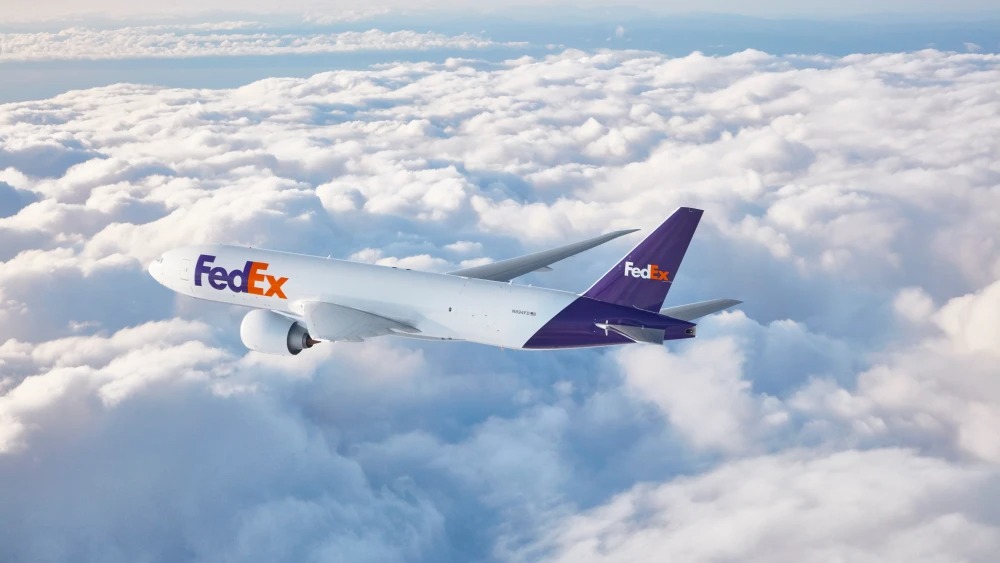

FedEx announced last week that it expanded its use of sustainable aviation fuel toward the end of 2025, adding Dallas Fort Worth International Airport and New York’s John F. Kennedy International Airport to its growing list of U.S. locations receiving blended SAF. With those additions, the company used the fuel at five major U.S. airports during the year, securing agreements totaling the equivalent of about 5 million gallons of neat SAF. FedEx said deliveries at DFW and JFK are being supplied through World Fuel Services at a minimum 30% blend.
“Expanding SAF use by FedEx to include our operations at DFW and JFK caps off a successful year of SAF deployments coast-to-coast,” said Karen Blanks Ellis, FedEx chief sustainability officer and vice president of Environmental Affairs.
World Fuel Services Senior Vice President Bradley Hurwitz said FedEx’s purchases demonstrate how existing fuel distribution networks can support access to lower-carbon fuel options, while DFW Vice President of Environmental Affairs and Sustainability Robert Horton said the agreement reflects collaboration among airlines, airports and fuel providers within existing infrastructure.
Earlier SAF Additions in Chicago and Miami
Earlier in 2025, FedEx said it began taking deliveries of blended fuel at Chicago O’Hare International Airport and Miami International Airport. At O’Hare, the company is receiving about one million gallons of neat SAF at a minimum 30% blend from Air bp, while Miami deliveries total roughly three million gallons from AEG.
FedEx said those efforts are part of a broader strategy that also includes aircraft modernization and fuel-efficiency improvement initiatives. The company said these follow its achievement of a 30% reduction in aircraft emissions intensity from a 2005 baseline in fiscal year 2024.
Global SAF Supply and Cost Challenges
The company’s expansion comes amid continued debate over the global pace and cost of adoption.
The International Air Transport Association (IATA) projects that global production growth will slow in 2026, reaching about 2.4 million metric tons, or less than 1% of total jet fuel demand.
“When SAF policy focuses on the air carriers and demand side of the equation, there is a risk of not concurrently building up the actual alternative fuel supply needed to comply,” Blanks Ellis acknowledged.
IATA Director General Willie Walsh has also warned that shortages of both SAF and new aircraft could make industry emissions targets harder to achieve, telling Reuters that progress toward net-zero goals is “definitely becoming more challenging.”
U.S. and European Policy Landscape
In the United States, SAF adoption is being shaped by a mix of corporate agreements, state-level programs and new federal incentives. The Clean Fuel Production Credit took effect in 2025 and ties tax benefits to lifecycle emissions performance. The credit applies to both aviation and non-aviation fuels, though producers have increasingly called for clearer guidance on eligibility and implementation.
In Europe, the ReFuelEU Aviation regulation mandates the increase of SAF blending at European airports. This started at 2% in 2025, but airline leaders have said supply constraints and higher costs remain meaningful obstacles to continued SAF growth.