















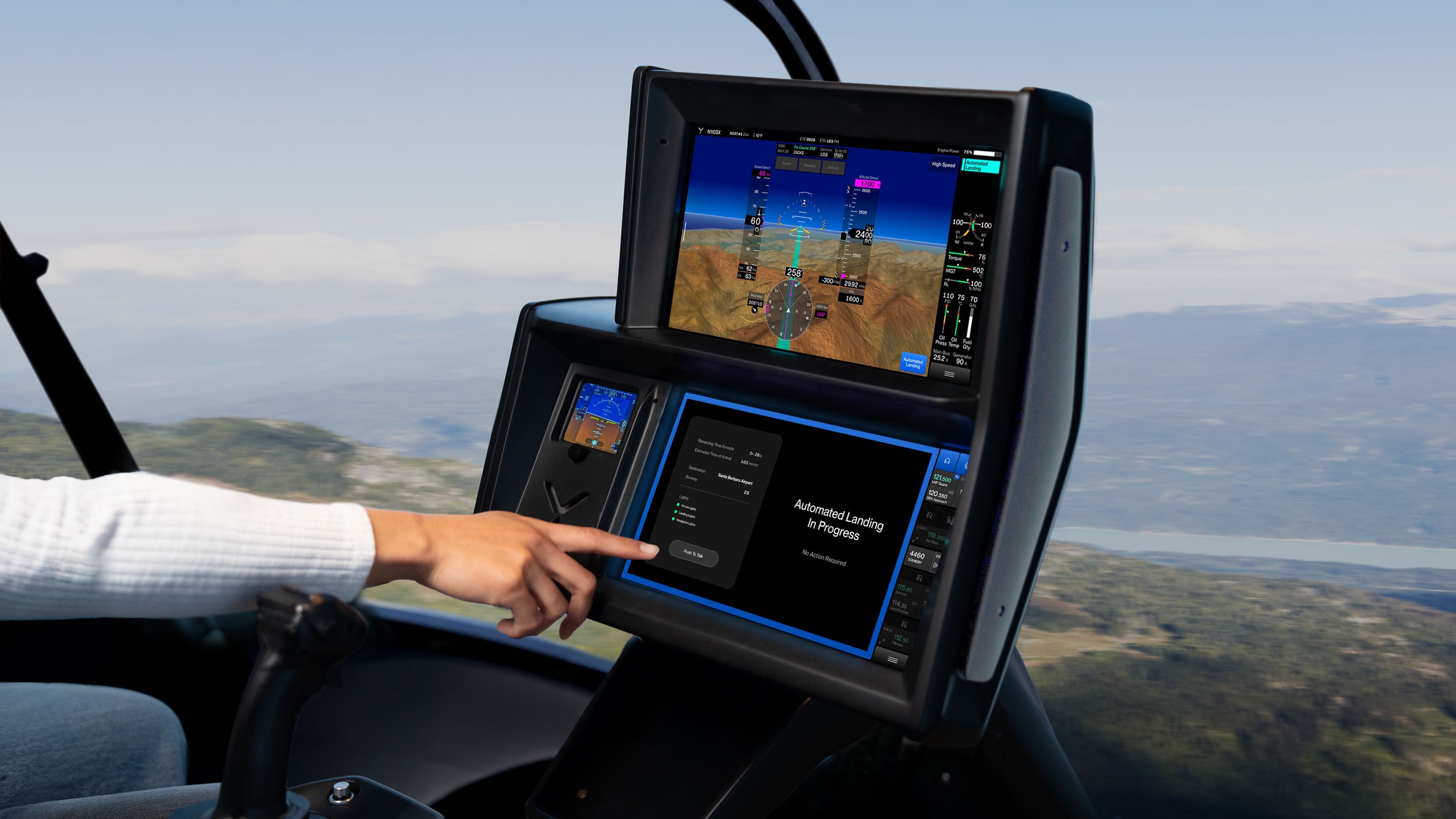

Aviation automation company Skyryse announced plans Thursday to introduce what it describes as a “universal” emergency autoland capability within its SkyOS flight operating system. The system would allow both helicopters and airplanes to autonomously execute a landing sequence during certain emergency situations. The company said the function is designed to allow a pilot or passenger to activate the system, after which the aircraft would autonomously manage the approach and landing.
Skyryse said the feature will rely on the system’s fly-by-wire architecture and onboard sensors to monitor altitude, speed and flight conditions while navigating to a landing location and managing power during the descent and touchdown. The capability is intended to support scenarios such as pilot incapacitation, spatial disorientation or severe weather encounters.
SkyOS is intended to provide automation tools to simplify flight across a broad array of aircraft. The operating system currently includes functions such as simplified flight controls, terrain awareness and envelope protection, which the company said would operate alongside the autoland feature.
Automated emergency landing systems have already seen limited real-world use. In December, a Beechcraft Super King Air completed an automated landing at Rocky Mountain Metropolitan Airport in Colorado using Garmin’s Autoland system after a pressurization issue.
Skyryse founder and CEO Mark Groden said the SkyOS-based system is intended to expand automated safety functions across a broader span of aircraft types. SkyOS is an in-development software-based flight operating system that integrates fly-by-wire controls, sensors and flight control laws into a single automation platform. The company said the system is designed to be adaptable across multiple aircraft types as part of aircraft equipped with the SkyOS architecture.
“By creating a holistic software-hardware solution like SkyOS, we’re able to develop and integrate lifesaving features like emergency autoland at unprecedented speed,” Groden said.
The company said development and certification of the capability for helicopter applications will proceed with regulators following certification of the Skyryse One aircraft.

Elon Musk has achieved that on the ground.
Oh! wait a min…
<g,d,r>
Tossla cars have difficulty with some street situations and geometries, such as a fork in road.
(Don’t have sense to stop and check map? :-o)
A competitor claims to have a better record than human drivers, though it is early to have enough data.