















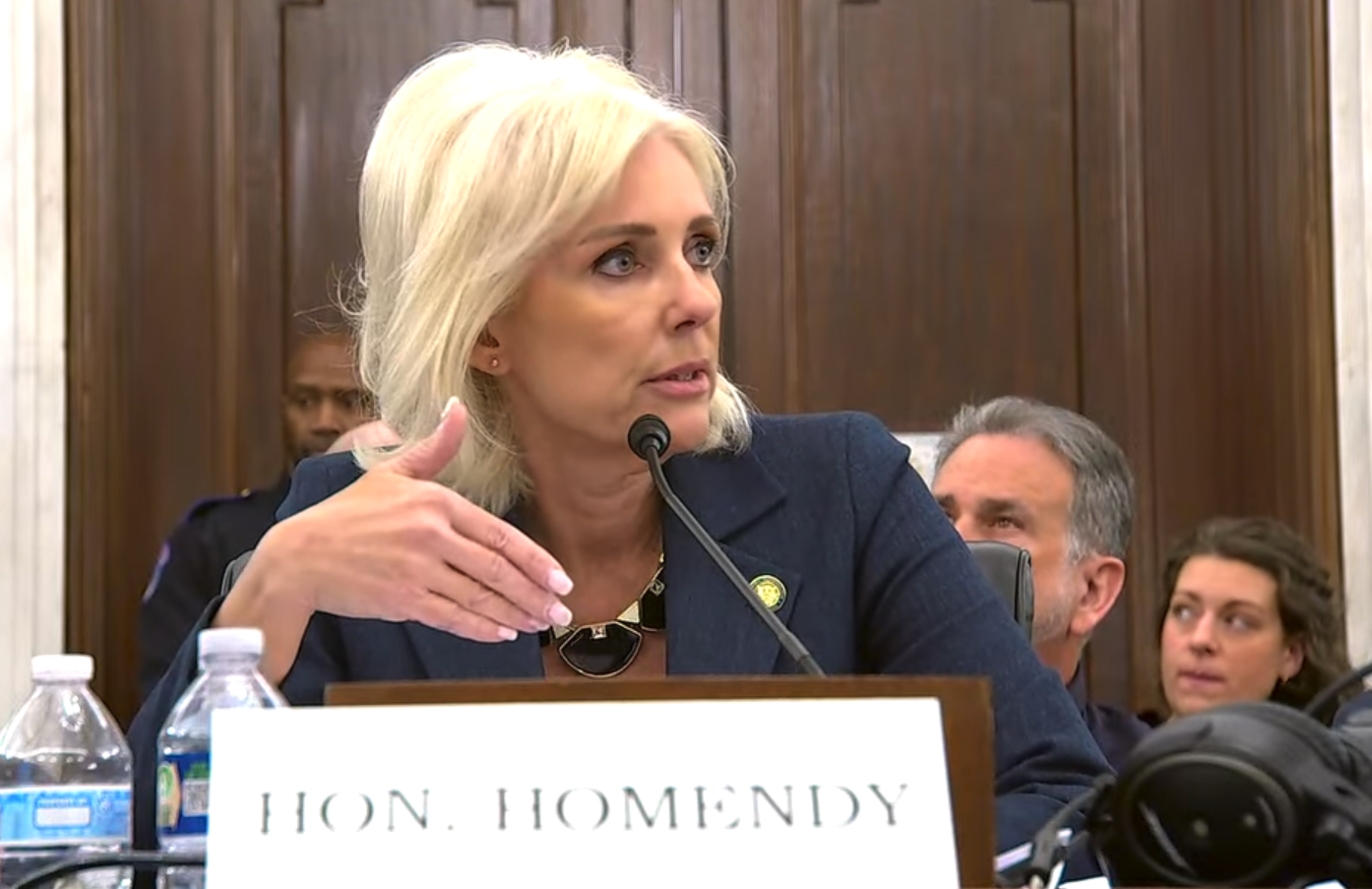

Senators questioned National Transportation Safety Board Chair Jennifer Homendy during a Senate Commerce Committee hearing Thursday. Although focused on last year’s DCA mid-air collision, questions directed toward Homendy from senators ranged from her views on ADS-B tracking requirements, aviation oversight and coordination between federal agencies.
Comments on ADS-B
In exchanges on ADS-B equipage, senators asked whether any aircraft operating in congested airspace should be exempt from uniform ADS-B requirements.
“No, absolutely not. It’s a shared airspace,” Homendy said.
She emphasized the accessibility of low-cost ADS-B In equipment and told lawmakers the technology provides pilots earlier awareness of nearby aircraft and described it as “life-saving information for pilots.”
These questions were largely asked in reference to the ROTOR Act, which passed the Senate unanimously late last year and currently sits with the House. It would require most aircraft that already need ADS-B Out to also carry and use ADS-B In by 2031. It also would tighten when government aircraft can turn off ADS-B Out and would expand FAA oversight, separation standards, and safety reviews, especially for rotorcraft and mixed-use airspace near busy airports.
Unheeded NTSB Warnings
Senators also sought Homendy’s perspective on the FAA’s performance, including coordination with the military, communication between agencies and how safety data is handled.
Homendy told lawmakers the DCA crash followed “years of unheeded warnings” and said recommendations had been “rejected, sidelined, or just plain ignored.”
Poor FAA Safety Culture
She also described broader concerns about the agency’s safety approach, citing what she characterized as a culture in which issues were not consistently addressed despite repeated warning signs. Homendy also noted that it was concerning that members of the FAA were often worried about discussing potential problems within the administration with NTSB investigators.
“Throughout our investigation, we found numerous people were afraid to talk to us,” Homendy said. “They didn’t want to be formally interviewed … Some people wouldn’t provide their names. I can’t tell you the number of people who were just scared to speak up because they were worried about retaliation.”
Lawmakers indicated oversight and legislative review will continue as they consider next steps related to aviation safety requirements and agency accountability.


FAA’s culture is dysfunctional in their approach to the medical process leading many with a medical requirement to profoundly mistrust them. hey are rigid with medical professionals’ in OK City passing judgements on people they never see and never will see. Sad agency with good people
After 22 years in the USAF and 25+ years in aviation manufacturing, I completely agree with what Homendy said about people do not want to be formally interviewed or go on record due to fear of retaliation. The fastest way to get skipped for promotion or to the unemployment line is to bring up serious issues that will either A. cost money or B. crate more work.
I’d like see the same enquiry in Canada. Our TSB should be pushing the safety agenda for ADSB IN/OUT on 1090/978. Satellite surveillance is an ATC billing scheme that is not safe. End the slipping slope of ADSB Mandates.
Any word from Congress acknowledging their members” part in the DCA crash by demanding flights home for them from DCA?
Former DOT/FAA inspector.
2006-2015.
Our budget for ONE year was fifty billion.
We did was “Obama” inspections.
The operators knew we were coming MONTHS in advance and gave us sanitized work orders.
If we found violations and the aircraft owner is an AOPA member, the AOPA attorneys whined to their congressmen that they were getting harrased.
Then we were told by managent to “look the other way” (or) dont “write up” a violation.
The FAA is in bed with the AOPA.
They are part of the problem by protecting owner/operators.
The FAA is also in bed with Boeing.
It was the FAAs fault 100% when the door plug fell off.
I could go on but it wouldnt do any good.
FAA: Feds Against Aviation
‘The FAA’s performance, including coordination with the military, communication between agencies and how safety data is handled’ can be summed up by how they acted recently in unilaterally shutting down ELP with no communication whatsoever with anyone else before acting.
There’s only one group responsible for this crash and it belongs to the DoD PBFA. Ref. DoDD 5030.19, DoD Responsibilities on Federal Aviation. There was no oversight and this accident should have not happen. Airspace or the NAS is critical for the life blood of our nation and the military is less than 1 percent of total operations compared to GA/commercial operations.
I see the problem in the Ptomac tragedy is FAA and Army not paying attention to the risks, including altimetry.
(I recall that the helicopter’s altimeter reading was off, and its crew were not attentive – and airliner crew might have been a bit low in curving path.
I have not read the expert study on altimetry in the NTSB’s docket.
Too much room for error in that situation.
When flying a base to final visual at night to that runway-an approach that I’ve done many times in the last 40 years- the airliner crew isn’t looking for traffic to intrude. They’re focusing on a stabilized approach that leads to grabbing the VASI or PAPI. once grabbed, the pressure drops dramatically as long as speed and config is correct. A successful landing is almost assured.
Having a fishfinder go off down low is almost something the one would think is erroneous or not credible UNLESS THE CONTROLLER SAYS THAT A BLACKHAWK WITH AN ARMY PILOT IS FLYING OUTSIDE THE ENVELOPE AND ON COLLISION COURSE. Like the short final at LAX with all kinds of ro wing jammin around low for crime fighting or traffic reporting or covering a news events or such. . Happened all the time, no conflict. There were always “down there” But proximate alerts were commonplace in class B.
NO FACTOR. DCA should have been NO FACTOR.
You’ll love this.
Once flying an MD80 on the visual backed up with the ILS 30 to KLGB outside the outer configured and stable we get a pop up TCAS with Traffic, pull up pull up. Red Box suddenly right there on the fish finder. I disconnect the AP, yank it up following commands TCAS on VSI F/O announces to tower and and it disappears. Nuisance? Malfunction? Didn’t see nothing. We’re at 2000 agl or so, and attempt to return to the path. Did so without difficulty and landed out of it. No bigs.
On deplaning at the gate, an Aussie dude from the back of the jet approaches and says emphatically “YOU MISSED HIM”! I’m like “missed who” he says “You didn’t see him”
I’m sinking inside and my knees are going weak at this point. He says they went right under the tail and could see the pilots faces in the Cherokee. Drove home to my family in Ventura completely stunned. TCAS BABY! Sweet Jesus.
Tower didn’t know nothing when called.
I believe maybe a flight instructor exited the ATA and forgot to activate his transponder then did so. Bang, there he was.
Well said!
Very well said
Correction flyboys, just read the post again, I misspoke.
“Pull up is not a TCAS command but an EGGPWS command.
Got all excited there. “Climb” was the command.
Sorry for the non pro language.
What is really absurd is that the FAA does not permit glider, balloon, or G/A pilots to use uAvionix SkyEcho ADS/B IN / OUT transceivers in the US. This battery powered transceiver is being sold in the UK for ~$650. The FAA won’t let it be used in the US because it is portable and doesn’t meet their gold plated ADS-B power output specs.
I have an ADS-B IN & Out equipped Motorglider. Most of the time, when I can see aircraft on my ADS-B display that are within a mile of my position, I can never see them visually, even though I know EXACTLY where they are. EVERY airplane should be ADS-B OUT equipped.
You say that word a lot. I’m not that word means what you think it means.
I’ve been teaching SMS for the last two years and it’s still baffles me what context she was talking about in the hearing when it dealt with Safety culture. Safety culture is normally associated with the operators the regulators, the FAA are there to evaluate if the safety culture exist, but they’re not in a position to create one for themselves.
In the rush to modernize America’s air traffic control (ATC), we’re leaving a cri?cal piece of the
safety puzzle in the shadows— and that’s a dangerous game. We’ve all heard the headlines: the
FAA is pouring resources into high-tech ATC upgrades. Sounds great, right? Except when we
shine the spotlight on ATC, we leave the people who keep planes and pilots truly safe out of the
picture. And that’s the Flight Standards Service.
Flight Standards is the FAA’s boots on the ground—the inspectors who ensure aircra? are
airworthy and pilots are truly qualified before they ever reach that shiny new ATC system. But
over the past decade, Flight Standards has quietly shi?ed from hands-on inspec?ons to
paperwork audits. They’re reviewing operator-generated programs instead of actually being in
the hangars or cockpits. We’ve basically turned the watchdogs into paperwork auditors. And
when inspectors disappear from hangars and cockpits, guess what happens? Mechanics and
maintenance providers start cu?ng corners, and pilots feel a li?le too comfortable because
they don’t believe they’ll be caught.
What does that mean for safety? Well, when you stop looking over the shoulder of maintenance
crews and pilots, you miss things. The ins?tu?onal knowledge that once kept risks in check is
fading. A shiny new ATC system can’t do anything about a maintenance issue that was never
caught or a pilot who didn’t get enough real-world oversight.
A shiny new ATC system can’t fix a maintenance shortcut that should’ve been caught by a
watchful inspector. It can’t correct a pilot’s training gap that only hands-on oversight would have
flagged. Focusing solely on ATC moderniza?on while le?ng Flight Standards atrophy is an open
invita?on for the en?re safety net to unravel.
If we want a truly safe Na?onal Airspace System, we need to put the spotlight back where it
belongs—on the inspectors who keep our skies safe from the ground up.