
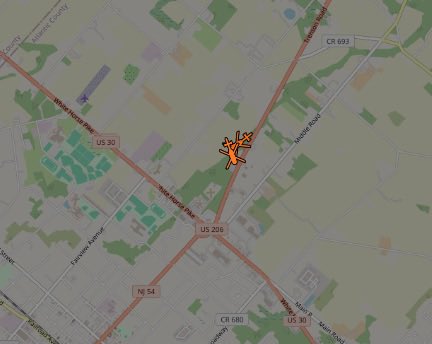

The National Transportation Safety Board this week released its preliminary report into a December midair collision involving two Enstrom helicopters near Hammonton, New Jersey, that killed both pilots.
The accident took place on Dec. 28, 2025, at about 11:24 a.m. local time and involved an Enstrom F-28A, N520H, and an Enstrom 280C, N280MG, both operated as Part 91 personal flights.
Flight Activity Before Collision
According to preliminary ADS-B data, both helicopters departed Vineland-Downstown Airport at about 9:48 a.m. and flew parallel routes to Hammonton Municipal Airport, arriving around 9:58 a.m. The report states that no ADS-B data captured the helicopters’ subsequent departure from Hammonton on the accident flight.
The report said that surveillance video reviewed by investigators showed the helicopters flying in close proximity, slightly staggered and on a similar heading, consistent with a formation-like flight.
As the flight continued, the helicopters converged until they made contact, the report said. According to investigators, video showed one helicopter entering a tumbling descent toward the ground, while the other pitched up sharply before leveling off, but then proceeded to yaw clockwise and descend rapidly before exiting the frame.
Weather and Ongoing Investigation
Meteorological conditions at the time of the accident were reported at 10 miles of visibility, light winds and an overcast ceiling at 1,400 feet agl, based on observations from Atlantic City International Airport. Neither pilot had filed a flight plan, and both helicopters were returning to Vineland at the time of the collision.
Wreckage and Impact Evidence
The accident took place about 1.5 miles southwest of Hammonton Municipal Airport and resulted in an aproximately 1,211 foot long debris path. Investigators reported that the first identified debris included paint chips consistent with the paint colors of both helicopters, followed by portions of main rotor blades and tail components.
The primary wreckage of N520H was found about 890 feet from the beginning of the debris path, with substantial damage but no evidence of fire. Primary wreckage from N280MG was located about 270 feet from N520H and was destroyed by a postimpact fire, though the tail cone remained relatively intact.
Further examination revealed paint transfer on the main rotor skin of N520H consistent with the tail rotor blade of N280MG. The wreckage from both helicopters was recovered and retained for further examination as the investigation continues.