
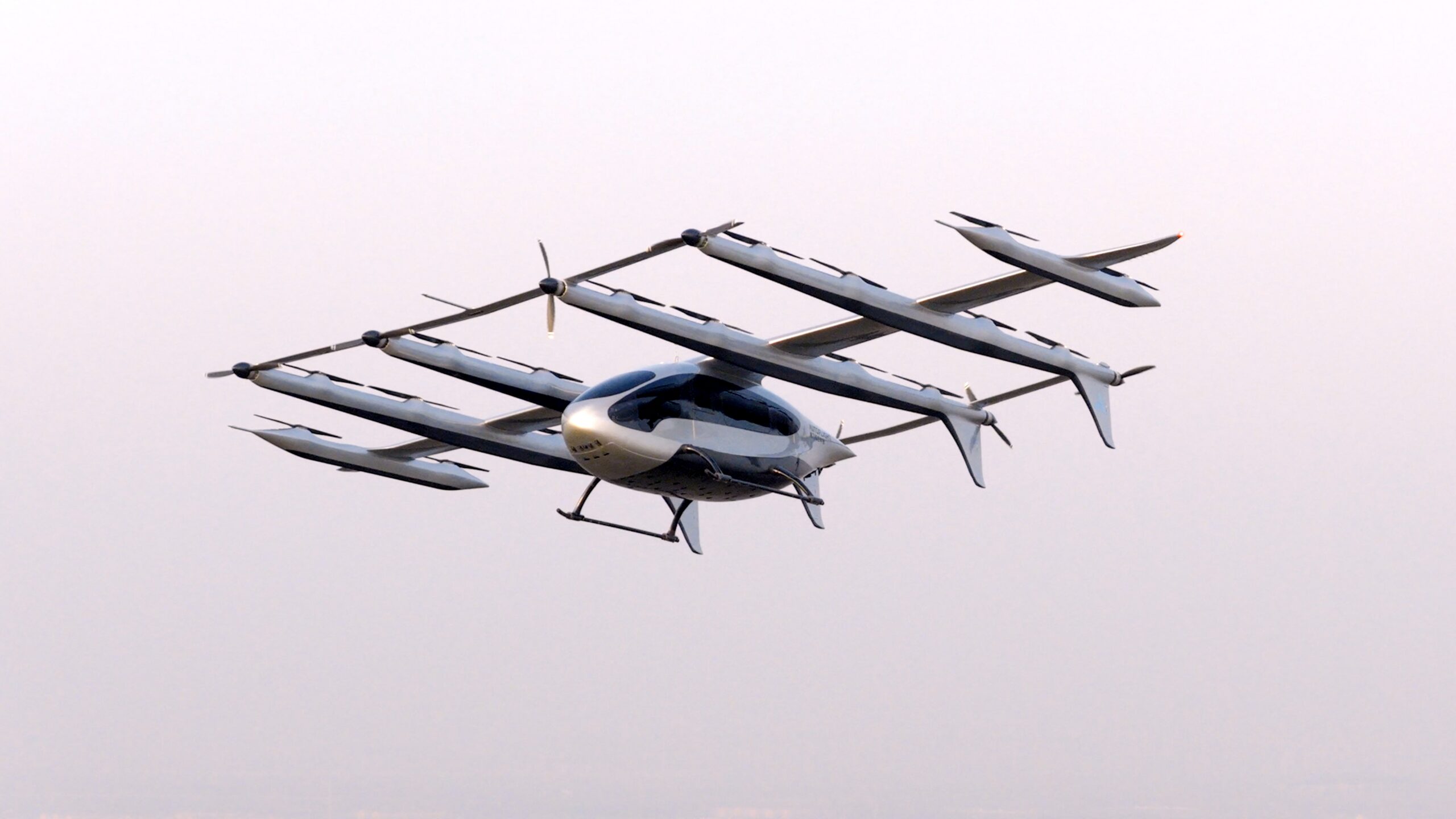

AutoFlight on Wednesday said it had conducted a public demonstration flight of its Matrix electric vertical takeoff and landing aircraft at the company’s low-altitude test facility in Kunshan, China. During the event, the aircraft completed a full transition sequence from vertical takeoff to forward cruise flight and back to vertical landing while operating alongside the company’s CarryAll cargo eVTOL. AutoFlight said the demonstration was the first time a 5-ton-class eVTOL completed a full transition flight.
The Matrix’s wingspan stretches about 20 meters (65.6 feet) and the aircraft has a maximum takeoff weight of 5,700 kilograms (12,566 lbs). The aircraft is being developed in passenger and cargo configurations. A passenger variant is designed for multiple seating arrangements, while the cargo version is intended to support ton-scale transport operations and accommodate standard air cargo containers through a forward-opening door.
AutoFlight said the aircraft uses a distributed propulsion system and a lift-and-cruise configuration, with both fully electric and hybrid-electric versions planned. The electric version is projected to have a range of up to 250 kilometers, while the hybrid configuration is designed for longer-range operations.
AutoFlight CEO Tian Yu described the aircraft’s intended role in future operations.
“Matrix is not only a rising star in the aviation industry but also an ambitious industry disruptor,” Yu said. “It will break the industry perception that eVTOL equals short-haul, low-load, and will reshape the rules of eVTOL routes.”
The Matrix program follows the company’s earlier work on other platforms, including aircraft developed for logistics and urban air mobility applications, as part of its broader low-altitude aviation development efforts, the company said.
The company’s smaller V2000CG CarryAll holds Type, Production, and Airworthiness certificates from the Civil Aviation Administration of China. AutoFlight announced in November that it would begin deliveries of the V2000CG by the end of 2025.