















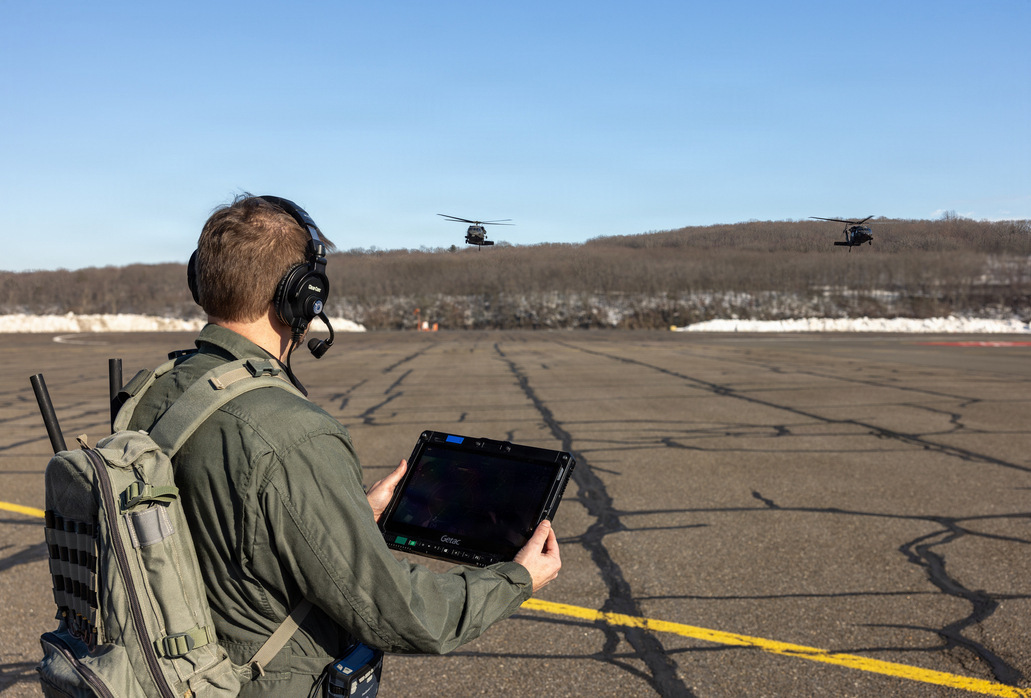

The U.S. Army announced Friday that it has taken delivery of an H-60 Black Hawk helicopter configured for both autonomous and piloted flight, beginning a new phase of testing focused on optionally piloted aircraft. The platform incorporates autonomy technology developed through the Defense Advanced Research Projects Agency’s (DARPA) Aircrew Labor In-Cockpit Automation System (ALIAS) program, which has been under development for more than a decade. According to the Army, the system is designed as a retrofit kit that can be installed on existing aircraft to automate flight functions and reduce pilot workload.
The aircraft is equipped with a fly-by-wire control system and an autonomy suite capable of managing flight operations, from takeoff to landing. The ALIAS kit includes a mission management system and software tools intended to allow for later expansions through integration of additional sensors and third-party applications. The Army said the helicopter can be operated with onboard pilots or controlled remotely from a ground station, and will be used to evaluate performance across a range of mission scenarios. Testing will also assess how the system performs in low-visibility environments and during complex operations.
Demonstrations of similar technology have been conducted in recent years by Sikorsky, including exercises in which a non-aviator soldier directed an optionally piloted Black Hawk using a tablet during Northern Strike 25-2. In those tests, the aircraft conducted cargo transport and simulated medical evacuation missions.
Sikorsky has also been developing related platforms, including the autonomous S-70UAS U-Hawk, along with civilian firefighting applications using MATRIX autonomy technology.
Delivery of the optionally-piloted Black Hawk comes as the Army continues restructuring its aviation branch. The service plans to reduce thousands of aviation positions in fiscal years 2026 and 2027 while expanding the role of autonomous aviation systems in military operations.


Blackhaws are expensive because they’re Human Rated. And humans need to be onboard when used for SAR and Medical Evacuations. And in many combat situations you want a human aboard to make decisions because he can see and evaluate far better than a remote drone operator.
Blackhawks are to valuable to use as drones and should only be flow by human pilots. When missions don’t require human presence (cargo delivery, suicidal/dangerous combat missions) use a cheap drone. Unless this just about a shortage of pilots as pilots are more expensive to train than drone operators.