















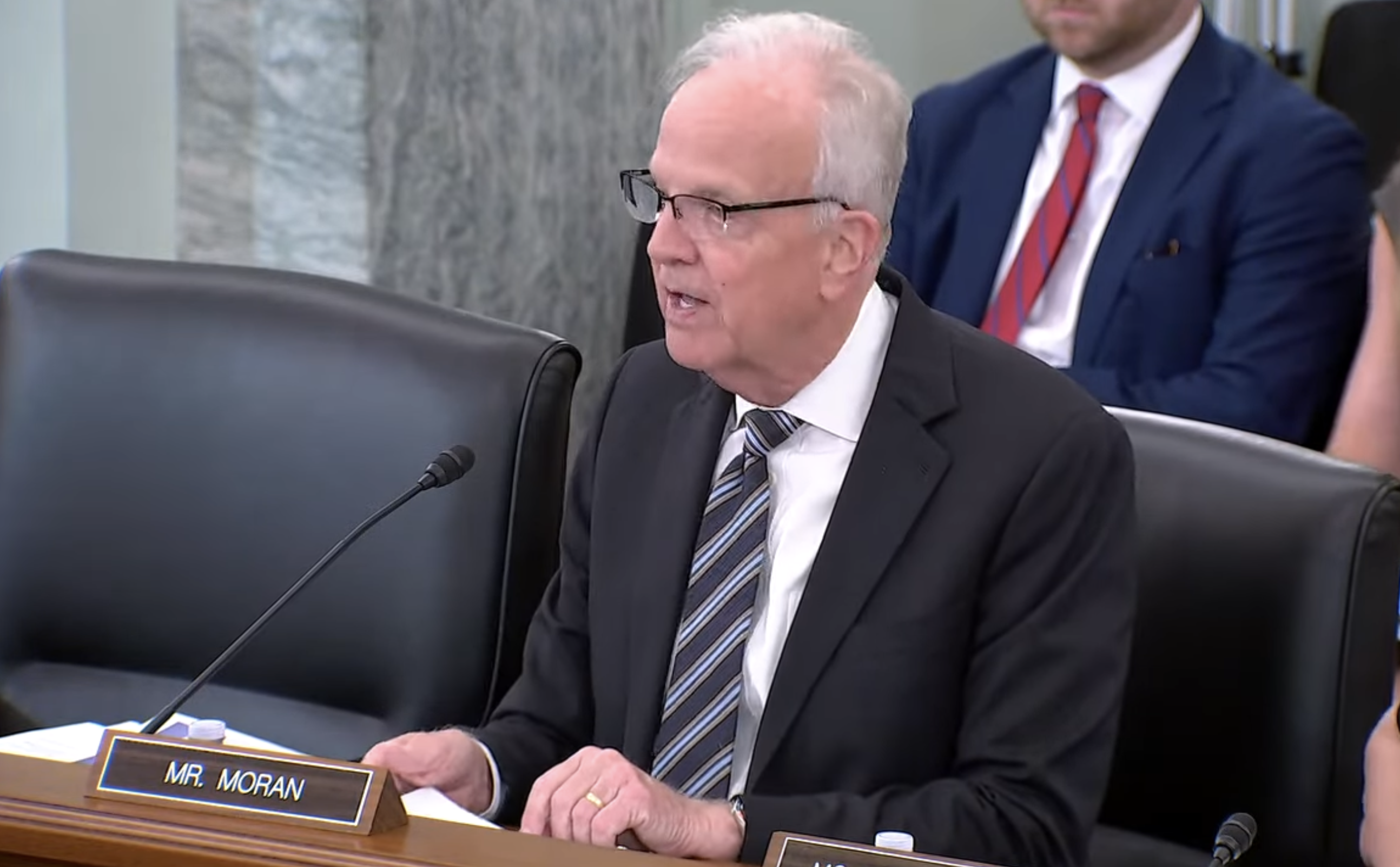

A Senate aviation subcommittee hearing on Tuesday largely centered on ADS-B In as lawmakers reviewed recent close calls and runway incursions across the National Airspace System.
The hearing was convened by Sen. Jerry Moran, R-Kan., chairman of the Senate Commerce Subcommittee on Aviation, Space and Innovation. Witnesses included representatives from Airlines for America, the American Association of Airport Executives, the General Aviation Manufacturers Association and the Air Line Pilots Association.
Moran opened the hearing by citing a recent go-around at Boston Logan International Airport. In the hearing announcement, Moran also said 15,000 close calls occurred over a three-year period in the airspace near Reagan Washington National Airport, where a deadly collision occurred in January 2025.
ADS-B In At Center Of Discussion
“The mid-air collision exposed a safety gap, a lack of an integrated ADS-B In mandate,” Air Line Pilots Association President Jason Ambrosi told the subcommittee. “Without it, pilots are forced to rely on last-second warning systems, like TCAS, that offer alerting time, insufficient call-out information, and are suppressed near the ground, like in the airport environment.”
The push for ADS-B In traffic displays has been part of the safety discussion for years, and the ROTOR and ALERT acts have recently added momentum. At the hearing, witnesses also pointed to certification, installation timelines and aircraft differences as factors relevant to how broader ADS-B in adoption could be carried out.
“New safety technology only reaches cockpits if the FAA has the resources and the workforce to certify it promptly,” General Aviation Manufacturers Association President and CEO James Viola told the subcommittee. “If FAA and global regulators harmonize the standards, if the supply chain can deliver parts, and if our maintenance and repair shops are ready near capacity and install it.”
The discussion focused heavily on the proposed ROTOR Act and its ADS-B In requirements. Ambrosi said integrated displays are needed so traffic and runway alerts are in the pilot’s normal field of view.
Viola said general aviation aircraft vary widely in capability and equipment, and he urged lawmakers to keep the requirements performance-based. Airlines for America President and CEO Chris Sununu said carriers support broader equipage, while also pointing to certification, manufacturing and installation timelines as issues that would need to be addressed.
Airport Surface Risks
Runway and taxiway awareness were also part of the discussion. Lawmakers referenced the March 22 ground collision at LaGuardia Airport involving an Air Canada CRJ-900 and an aircraft rescue and firefighting vehicle. Preliminary findings for the accident said the airport surface detection system did not issue an alert because the vehicle was not equipped with a transponder.
“In the airport environment, surface surveillance tools are expected to be in place at more than 200 airports in the months ahead,” American Association of Airport Executives President and CEO Todd Hauptli told the subcommittee. “These systems promise to enhance safety and mitigate near misses and can be bolstered with the installation of vehicle movement area transmitters where possible.”
Workforce, Data And Training
The hearing also addressed smaller airports, non-towered operations and contract towers. Hauptli said broad ATC modernization would benefit large and small airports, including towered and non-towered fields. He also cited FAA deployment of surface awareness systems and legislation that would require situational awareness displays at contract towers that do not have the STARS platform.
Witnesses also discussed safety management systems, runway driver training, data sharing, controller staffing, weather tools and FAA modernization programs.
Sununu said Congress should build on a $12.5 billion down payment toward ATC modernization, and witnesses said better information sharing could help identify risks earlier across airlines, airports, pilots, controllers and other aviation stakeholders.


ADS B is a wonderful tool; if installed and on.
Cost is an issue for GA.
The world needs affordable systems with satellite capability; the world standard.
Mandated systems must be worldwide frequency, 1080, not limited to the unique US low altitude frequency.
Ground vehicles with airside access require ADS B out at least.
ADS-B in is advisory only, you cannot follow ADS-B advisories without a specific clearance from ATC when IFR like TCAS allows. Until then I have no intention of spending thousands for ADS-B in like the ALPA unions want with the Senate bill. ADS-B was sold to operators as a way to reduce separation minimums and to increase traffic. That has not happened.
ADSB was sold as a safety tool. I can leave tools in my toolbox until I need them. That describes the Transponder Veil. I didn’t have to turn it on unless I was going to enter the veil. ADSB was sold as a replacement for the transponder.
Then they made it mandatory 24/7 if installed. You can’t even taxi across a grass, uncontrolled field in class G without your ADSB on if it’s installed, and the penalties are harsh. This is not what we were sold. This is not a simple direct transponder replacement.
Then came the fraud. People are registering their ADSB with someone else’s tail number. A man with an unfinished homebuilt has received bills for landing fees. Oh yeah, then came the ADSB generated landing fee. They are going to inch it over the goal line to force everyone into the ADSB pool, cluttering up the ATC screens with every glider, balloon, drone and ultralight that has an engine running in a 100 mile radius. That won’t improve safety, or support your freedom to travel.
It’s time for a deep breath and return to the Transponder rules. If you’re going into the bus station with your moped, you need it on. Outside the veil, let free men travel freely.