















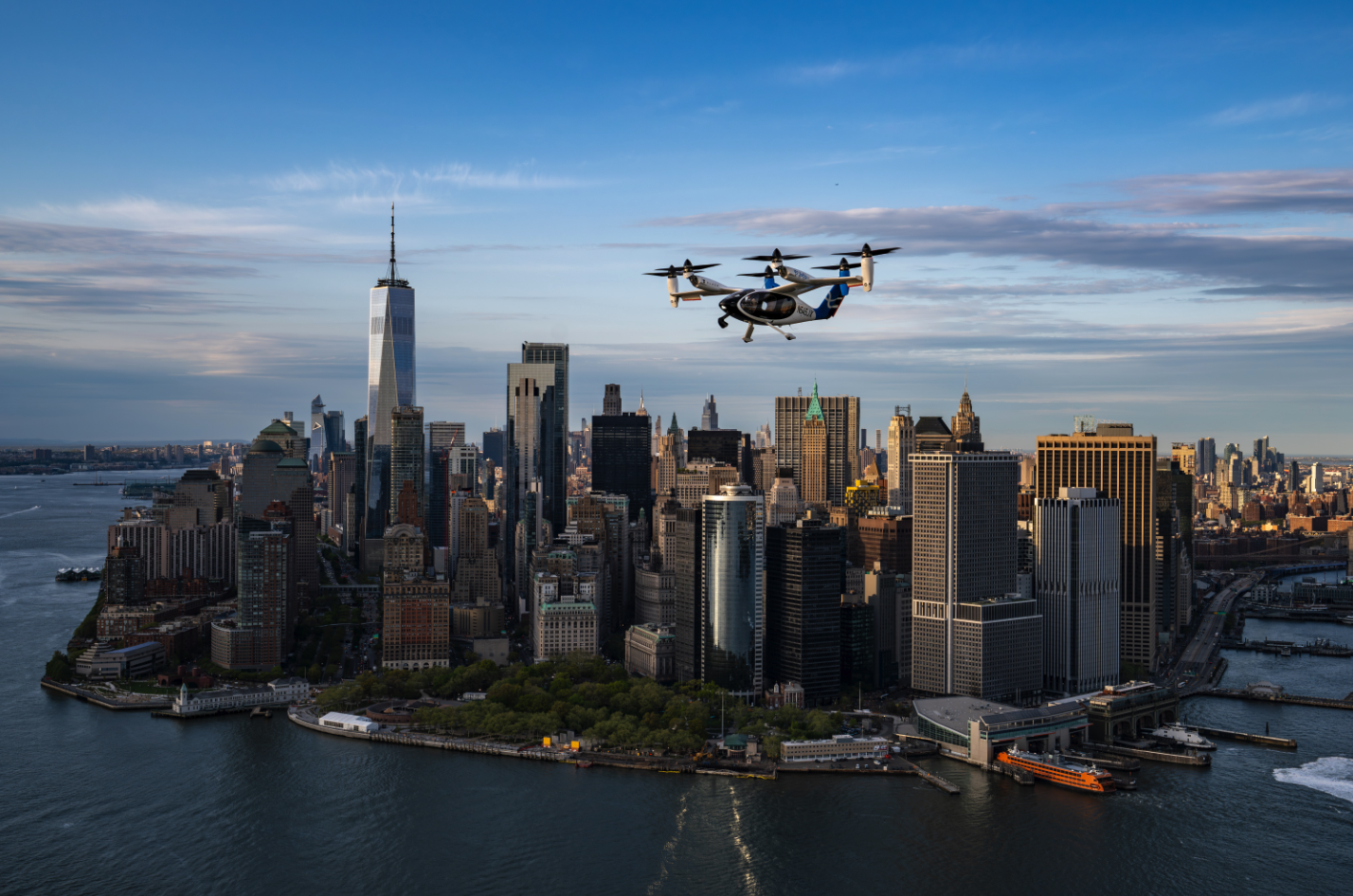

Joby Aviation said it has completed a series of electric vertical takeoff and landing (eVTOL) demonstration flights in New York City, including flights between John F. Kennedy International Airport and existing heliports in Manhattan.
The company said the flights included stops at Downtown Skyport, West 30th Street Heliport and East 34th Street Heliport. According to Joby, the routes reflect some of the service patterns it is considering for the New York market, including flights between JFK and Manhattan, which it says it will conduct in under 10 minutes. The campaign was coordinated with support from the Port Authority of New York and New Jersey as part of the FAA’s eVTOL Integration Pilot Program (eIPP).
“New York has always been a city that defines the future by demanding better,” Joby founder and CEO JoeBen Bevirt said. “We first flew here in 2023, and now we’re showing what the next chapter looks like: a quiet, zero operating emissions air taxi service designed to better serve New Yorkers. This week, flying between JFK and Manhattan, we showed what the White House-backed eIPP initiative makes possible and offered New York a look at what’s coming.”
The New York flights are part of the company’s 2026 Electric Skies Tour, which has so far demonstrated flights in the San Francisco Bay Area before the New York flights. The company is continuing work toward FAA certification and said its first conforming aircraft for type inspection authorization recently flew in a step toward FAA for-credit testing. Joby also acquired Blade Air Mobility’s passenger business in 2025, giving it access to existing passenger infrastructure in the New York area.


I would like to see engine failure flight testing done in the same way any other aircraft is tested.
It has 6 motors which are far more reliable than any internal combustion engine any will continue to fly with any single motor failure. Even if you lost all power, it is still capable of gliding as a normal aircraft with an engine out. This has to be much safer than a helicopter along with being much less expensive in terms of fuel and maintenance.
As Joby continue their flight testing, which has shown success, I hope they can continue to prove that they have designed a system capable of enough redundancy to overcome failures of multiple electric motors or propellers. This aircraft is designed to be a VTOL aircraft. Six motors, or ten, doesn’t matter. In an asymmetric thrust scenario during any portion of flight that does not have enough relative wind over the lifting/control surfaces an aircraft will be out of control, and will be about as controllable as a rock. Simple physics. The V-22 has proven that time and again. I’m not arguing the viability of these new designs, but they need to continue to be thoroughly tested to prove their airworthiness, or ability to safely land in a catastrophic engine/motor failure situation, just as any fixed/rotor wing aircraft would be tested, before certification. A fixed wing aircraft can glide to a hopefully safe spot. A helicopter can autorotate given enough altitude. A VTOL aircraft with two or more motors required for flight, such as this, losing enough thrust to produce an asymmetrical situation, will be uncontrollable.
As a New Yawker, I noticed almost a total lack of helicopter flights recently. Upon reading this experimental e-heli test flight from JFK to several heli pads in Manhattan before returning to JFK, I discovered NYC restricting tourist flights by helicopters since 4/25 from noise issues. If e-helis are FAA approved for commercial flights, they may be the next step easily meeting noise abatements from metropolitan areas like NYC with heavy air traffic from JKF, Newark and Laguardia.